
 On eBay Now...
OUTLAW WILBUR UNDERHILL JR. (1901-1934) KILLED FBI letter to sister gangster For Sale
When you click on links to various merchants on this site and make a purchase, this can result in this site earning a commission. Affiliate programs and affiliations include, but are not limited to, the eBay Partner Network.

OUTLAW WILBUR UNDERHILL JR. (1901-1934) KILLED FBI letter to sister gangster:
$3000.00
A truly rare and significant piece of American crime history: an original handwritten letter from infamous Depression-era outlaw and bank robber, Wilbur Underhill Jr. (1901-1934), often dubbed the "Tri-State Terror" and "Mad Dog."
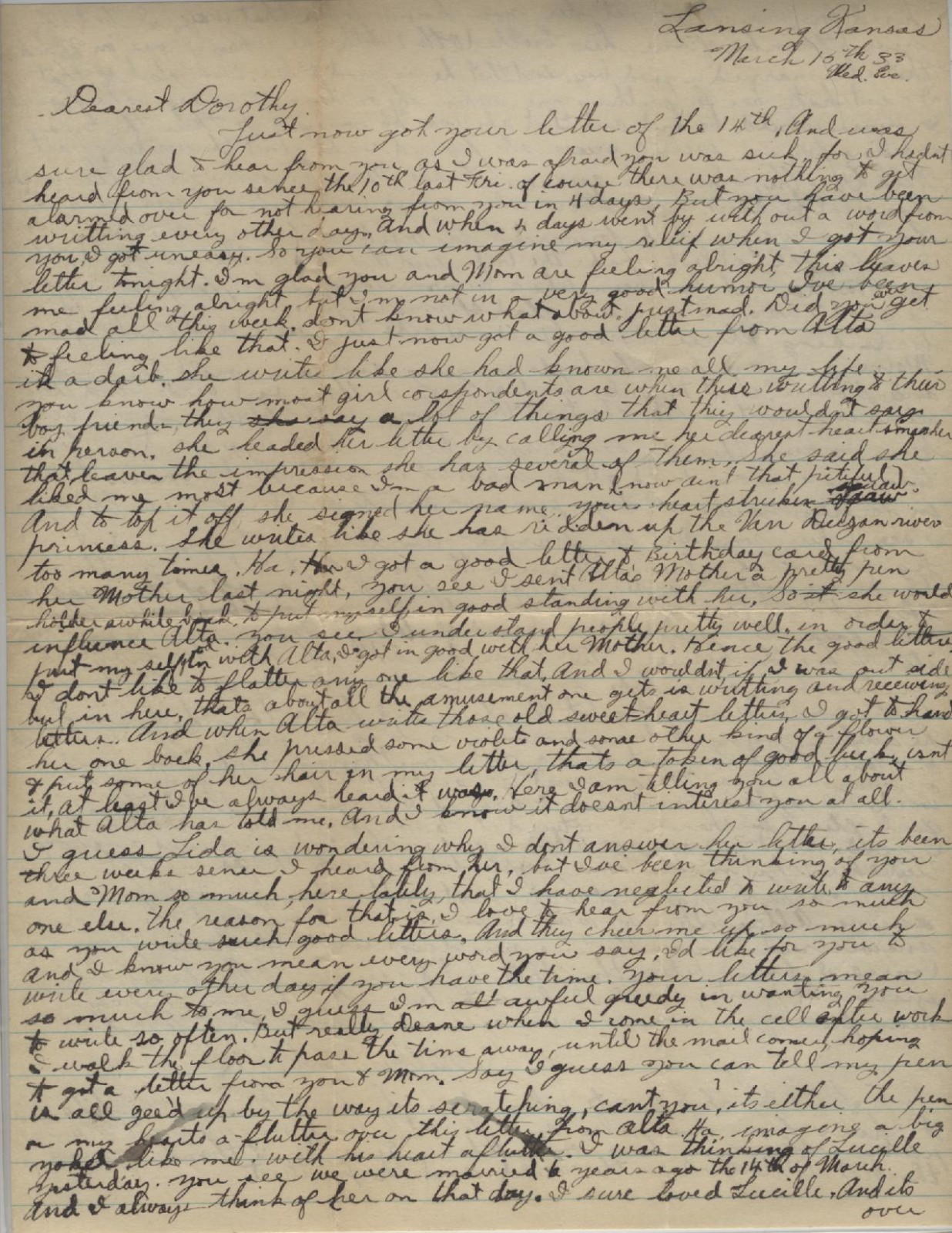
The letter is penned to his sister, Miss Dorothy Underhill, in Kansas City, Missouri. The envelope is postmarked March 1, 1934 from Lansing, Kansas, which corresponds to the date on the letter, March 1st, 1934. This date places the letter as one of the very last known communications from Underhill, written while he was hospitalized under guard after being mortally wounded by a combined force of FBI agents, police, and sheriff's deputies. He died just days later on March 6, 1934.
Sender: Wilbur Underhill Jr.
Recipient: Miss Dorothy Underhill, 220 South Bales, Kansas City, Missouri
Date: March 1st, 1934
Significance: Written from the hospital where he was held after his final, fatal shootout with law enforcement.
A must-have for collectors of true crime, Depression-era Americana, and outlaw memorabilia.
✍️ Full Letter TranscriptionThe letter is two pages long, dated Lansing, Kansas, March 1st, 1934.
Page 1:
Lansing KansasMarch 1st 34
Dearest Dorothy,
Well dear I just now got your letter of the 16th and was sure glad to hear from you as I was afraid you was sick or might heard from you when the folks last. Dorothy there was nothing for you to worry about for not hearing from me for a long time. You know I don't get very much time to write and when 4 days went by without a word or writing every other day you can imagine my relief when I got your good ole message. Yes I can imagine your relief when you got my letter too. I'm glad you and Mom are feeling alright this severe cold weather. I'm alright. I'm not in a very good humor though. Don't get me wrong I’m not blue and don’t worry about [missing word]. You know I get a certain feeling and now don't know what about it. Just need my Alta little [sic] finger. I'm glad you and Mom are feeling alright. I got down on my knees and said to my mat in a very good humor just before I got your letter and I got up feeling like that. I just now got a good little prom letter.
Alta dear, the writer is like she had known me all my life and this for just friends. She doesn't go around any one else, it will be up to their person. She leaded her little girl's colony and she always pays them a visit in person. She leaded her little girl's colony and she never told me why they haven't the mission or she has re-tired of them. She ask me if I want to join. I told her I’d be glad to. She has a very small town of a chicken world and told me I'd fill it. She has a stem of the Kin Hudsonmore Princess. The writer is she has a stem of the Kin Hudsonmore too many times. She has got a good little Alta hair and I am her Mothers last night. You see I told the Mother I'm not so she would not be alright. You see I'm in good standing with her. So that she would not be alright. You see I'm in good standing with her. She told me I'm in good standing with her Mother, since she understands my letter with (the words) in good with her Mother. Since she understands my letter with Alta. She is a very pretty little girl.
Alta I got a good little birthday card from my little sister and a gift of money to send my mother a pretty pin. Alta I don't like to talk too much on the subject, because that kind of a thing is not necessary to talk in here. That is all the amusement we get is writing and receiving letters, dear, when Alta wrote that old sweet heart letter I got a love letter back. She pressed some violets and some that kind of a thing. I got a bunch of violets and some of her hair. I'm sending some to Mom and some to you. Dear don't go telling you all about it. At least let me be always kind. I wish I was. I don't interest you at all. I guess you'd be wondering why I don't answer by letter. It's been over since he knew I heard from him. But we keep thinking of you and Mom so much, here lately, that I have nearly lost a word. Only one else. The reason for that is, that I have heard from you so much as you write such good letters and they cheer me up. You like it when you get a letter from me, every word you say. I'd like for you to write every other day if you have the time. My delicate organi[zation] worries me too, I guess I'm all out of practice in wanting to write so often. But really dear, when I'm on the cell after work it would be floor to hair the time away until the mail come. Hoping to get a letter from your Mom. I guess you can tell my Pen is all good. By the way, it's a silly thing, can't you, to either the pen or my agate a flurry. You see I'm all on edge for missing a big word. Did you think of me on heart of [missing word] ? I was thinking of you both yesterday. You see we were married 6 years ago the 18th of March, yesterday, I sent a flower on that day. I sure love Lucille and do (end of page 1, turns over)
Page 2:
hard for me to forget her. You know I look that way. I bet she never thinks of me. Her brother (brother) I told one when I was in Mich. that she married a good boy, and that he is good to her. I'm glad of that. I can't hate her for quitting one, when she quit me. I guess all the ground is now would be that and that she was wrong. I'm glad of that. I guess all the ground is now would be that and that she was wrong. I'm going to start waiting for me, well I guess she is figured right. She is still at the part.
Well Dorothy, I'm sure anxious to see Mom tomorrow, all this week has went by slow. You know when one is waiting, time sure drags. And I always look forward to the visits with your mother and I hope she's able to make the trip, and that the weather is good, the last two days it has been like a summer day. And I only tomorrow it is good and warm. I'm sure glad spring is here. I like to hear the birds sing. They are a grove just out side the wall, and early of a morning, I can hear the birds singing, and I can smell the woody flower. Out the only birds I hear is the three pay birds, and their singing ain't so hot, about all they sing is the blues. They were working these jig saw puzzles. I'm about jogged out. I didn't think any one could get interested in such foolishness. I see where some Dr. has found a new disease, he remedied it. The saw it, it claims women is the most apt to catch it, their hands are softer and tender. It is caused from the germs off of the paper. They get it on their hands and then they can't quit on it. They can't quit on it. I'm sure you will be glad to hear of it, but the jig saw itch takes the berries.
Well I'm glad Hugh has been able to work some. Sure hope he can land a steady job. He can help your Mom out a lot. Hugh's a good kid. I think I like him. He is awful young. He is nervous too, to hug. He ought to get some kind of a tonic. I see he is on my girl. Soon she may give me a nice work. I'm an old one myself. You see I haven't got a thing to occupy my mind. Well I'll explain how I came to know it. I'll give them the dictionary a good look, and I'll explain how I came to know it. I'll give them the dictionary a good look. I'll explain how I came to know it. I'll give them the dictionary a good look. Well I'll explain how I came to know it.
Well I'll explain how I came to know it. I'm always glad of a chance I noticed it. Do you remember what a girl wrote about 3 years ago when a girl wrote that. It missed every thing. The only thing that maybe some people believe such things as that.
Miss Dorothy, may not write me such a good one and end the answer. Alta's letter sure wins me sure drags until she hears from me. Answer real soon as the time sure drags until she hears from me. Conve & grow better than that, but I can feel the little girl. I'll have to close for this time. Hoping to hear from you soon, I remain with lots of love, XXX
Wilbur Underhill.
P.S. Tell Hugh to write when he has time, as I like to hear from him. Also don't forget to send me your & Mom's picture when you have some time. Remember I think you are the best little girl in the world, and the prettiest.
🔪 Wilbur Underhill Jr. BiographyWilbur Underhill Jr. (March 16, 1901 – March 6, 1934) was an infamous American criminal, bank robber, and Depression-era outlaw. Known by the colorful monikers "Mad Dog" and the "Tri-State Terror," he was one of the most sought-after bandits in the Southwestern United States during the 1920s and 1930s.
Early Life and Criminal Career: Born in Joplin, Missouri, Underhill began his life of crime early, with his first conviction for burglary in 1918. He spent much of his life in and out of various prisons, including the Missouri State Penitentiary, where he was incarcerated alongside his three older brothers, all of whom were career criminals.
The Tri-State Terror: Underhill was known for his extreme violence and frequent escapes. His criminal history included convictions for burglary, armed robbery, rape, and multiple murders of law enforcement officers and civilians. He was known for leading a gang that operated across Oklahoma, Kansas, and Missouri.
The Notorious Escapes: Underhill gained notoriety for his "slippery" nature while incarcerated. He successfully escaped from multiple jails and prisons, including the Oklahoma State Penitentiary in 1931 and a mass escape from the Kansas Penitentiary in 1933, where he led ten other prisoners out.
The End of the Outlaw: Following his 1933 escape, Underhill was a suspect in numerous bank robberies across several states. His crime spree ended on December 30, 1933, when a massive, combined force of FBI agents (then the Bureau of Investigation), local police, and sheriff's deputies located him hiding in a boarding house in Shawnee, Oklahoma. A fierce gun battle ensued, and Underhill was critically wounded.
Death: Underhill was the first major underworld figure of the 1930s crime wave to be shot and killed by federal agents. He was held in the hospital under heavy guard until he succumbed to his injuries on March 6, 1934, at the age of 32. This letter, dated March 1st, 1934, was written to his sister just days before his death.
The Outlaw's Final Words: Wilbur Underhill Jr. Letter (March 1, 1934) 🚨
This is a chilling, historically significant piece of American crime history: a letter penned by notorious Depression-era outlaw and bank robber Wilbur Underhill Jr. ("Mad Dog," the "Tri-State Terror") just five days before his death from wounds sustained in a massive shootout with the FBI. Written from the hospital under heavy guard at Lansing, Kansas (postmarked March 1, 1934), this letter to his sister Dorothy is an intimate, final communication from one of the most violent and wanted men of his time. The envelope itself serves as a stark reminder of his final location before his demise at the hands of law enforcement.
An extremely rare and poignant artifact from the life of "Tri-State Terror" Wilbur Underhill Jr. (1901-1934). This lengthy, two-page letter, dated March 1, 1934, offers a unique and personal look into the mind of the notorious outlaw, revealing his anxieties, affection for his family ("I'm sure glad spring is here. I like to hear the birds sing"), and musings on life and human nature just days before his death. Letters from Underhill are seldom available, and one written from the hospital following his fatal encounter with the FBI is exceptionally scarce, representing one of his absolute last documented Underhill Jr. (March 16, 1901 – January 6, 1934), often called "Mad Dog" or the "Tri-State Terror", was an American criminal, burglar, bank robber and Depression-era outlaw. He was one of the most wanted bandits in Oklahoma during the 1920s and 1930s and co-led a gang with Harvey Bailey that included many fellow Cookson Hills outlaws including Jim Clark, Ed Davis and Robert "Big Bob" life and criminal career
Wilbur Underhill Jr. was born Joplin, Missouri on March 16, 1901, one of seven children. His three older brothers Earl, George and Ernest all became career criminals, though none gained the notoriety of Wilbur, while his three sisters led law-aoffering lives. When Underhill was 12 years old, his brother George killed a local peanut vendor and was sentenced to life imprisonment. Underhill began to show a wild streak soon afterwards though his mother claimed it was the result of a childhood accident that "didn't leave him quite right". He also changed the spelling of his given name from Wilber to Wilbur believing it sounded more manly.[1]
Underhill committed his first criminal offense by stealing silverware from a neighbor's home. When questioned by police, he attempted to convince them that a stranger had given it to him. In 1918, he was convicted of burglary and spent four years in prison. A year after his release, Underhill became locally known as the "Lovers Lane Bandit". When his identity became known, after being caught by a police decoy, he was sent to the Missouri State Penitentiary for five years.[1]
Crime spree with Ike "Skeet" Akins and the murder of George Fee
Underhill was released on parole in late 1926, and on Christmas Day he and Ike "Skeet" Akins robbed a drug store in Okmulgee, Oklahoma. In the course of the robbery, 19-year-old customer George Fee was killed. They were eventually arrested on January 7, 1927, and charged with murder and armed robbery. Underhill and Akins were still awaiting trial when they decided to escape from the Okmulgee jailhouse on January 30 with fellow inmates Red Gann and Duff Kennedy using smuggled hacksaws. While Underhill successfully eluded authorities, his partner was captured at Lamar, Missouri on February 9. Three days later, while being brought back to Okmulgee, Akins attempted another escape and was killed by Sheriff John Russell.[1]
A day after Akins' death, Underhill robbed a movie theater for $52 in Picher, Oklahoma. Confronted by Constable George Fuller, he grabbed Fuller's pistol and killed a deputized civilian, Earl O'Neal, before escaping. Underhill was finally caught in Panama on March 20 and taken to Okmulgee where he was convicted of the Fee murder and sentenced to life imprisonment on June 3, 1927.[1]
Escape and Frank Underhill
Underhill made several attempts to escape from the Oklahoma State Penitentiary and finally succeeded on July 14, 1931. Twelve days later, Underhill purchased a car in Cherryvale, Kansas under the name Ralph Carraway and robbed a local theater of $300 that same day. The following month he recruited his young nephew, Frank Underhill, to join him on a new crime spree. On August 12, they robbed a Wichita gas station but got only $14.68. While leaving the scene of the robbery, Underhill crashed into another car and had to have it towed to a nearby garage and checked into a hotel.[1]
The next day, Patrolman Merle Colver arrived at the hotel. He had been assigned to check Wichita hotels for suspicious guests and went to their room to question them. When he knocked on the door, Wilbur Underhill shot him 3 times in the head killing him instantly[2] Fleeing on foot, Underhill became involved in a running gunfight with police. A 2-year-old boy was killed in the crossfire when police fired at Underhill. He was eventually stopped by a lucky shot to the neck. Wilbur Underhill was convicted of murder, earning him another life sentence, and was imprisoned in Lansing state prison on September 4, 1931. Frank Underhill was not charged and, apparently "scared straight" from his experience, never committed another criminal offense for the rest of his Gang
By the early 1930s, Underhill had become one of the most notorious bandits in Oklahoma. While an inmate in Lansing, he participated in a mass escape with 10 other inmates using pistols smuggled in by Frank "Jelly" Nash and headed for Cookson Hills. Among those included in the jailbreak included fellow outlaws Harvey Bailey, Jim Clark, Frank Sawyer, Ed Davis and Robert "Big Bob" Brady on May 30, 1933. Many of these men later became members of the gang headed by himself and Bailey as they set off on a crime spree lasting a little over six months.[1]
Almost two weeks after their escape, on June 16, he and Bailey led a robbery with several other men robbed a bank in Black Rock, Arkansas. The next day, Underhill and Bailey were among several fugitives wrongly named as participants in the Kansas City Massacre, a failed attempt to free Frank Nash from police custody, resulting in the deaths of Nash and the four lawmen guarding him. The gang continued its activities and robbed $11,000 from a bank in Clinton, Oklahoma. Two days later, Underhill apparently acted alone in a bank robbery in Canton, Kansas but rejoined the gang by the time the Bailey-Underhill Gang struck a bank in Kingfisher, Oklahoma on August 9, 1933.[1]
Return to the Cookson Hills
Three days after the Kingfisher robbery, Bailey was visiting Robert Shannon, father-in-law of Machine Gun Kelly, at his Texas ranch and safehouse when police and federal agents raided the property. Bailey had been passed ransom money from Kelly's kidnapping of oil tycoon Charles Urschel and wrongly convicted in the plot two months later.[1]
With Bailey serving a life sentence, Underhill took charge of the gang. On October 6, he and several unidentified men robbed $3,000 from a bank in Baxter Springs, Kansas. These were followed by bank raids in Galena, Kansas and Stuttgart, Arkansas. On November 9, he and Ford Bradshaw raided an Okmulgee bank with a few other men and escaped with $13,000.[1]
Underhill was now attracting national media attention. He had been called "Mad Dog" or the "Tri-State Terror" by several newspapers, one even dubbing him The Southwest Executioner, while authorities made efforts to go after them almost immediately following the Okmulgee heist. A special task force was formed, and included armored cars, and searching through Cookson Hills looking for him. On November 18, while the task force was still in Cookson Hills, Underhill presented himself at the courthouse in nearby Coalgate and applied for a marriage license under his own name. His fiancée, Hazel Jarrett Hudson, was a sister of the outlaw Jarrett brothers. As part of a wedding present for Hazel, Underhill and several others robbed a bank in Frankfort, Kentucky.[1]
Pursuit by the FBI
FBI Director J. Edgar Hoover, reportedly frustrated with the lack of progress from Oklahoma authorities, assigned agent R.H. Colvin to the Underhill case. Colvin soon discovered that Underhill had given his wife's address in Oklahoma City to the minister who married them in order to receive their marriage certificate. Federal agents staked out the home and spotted the Underhills a week later. Agents at the scene called for reinforcements but, by the time they arrived, the newlyweds had left to celebrate their honeymoon. A few days later, police raided a farm near Konawa where they knew Underhill was staying. However, Underhill had passed them earlier on the highway and was able to escape before police realized their mistake.[1]
Underhill and his gang continued to remain active in the area. Underhill, Jack Lloyd and Ralph Roe attempted to burglarize a bank in Harrah, Oklahoma on December 11, 1933, and robbed another bank in Coalgate two days later.[1]
Shawnee ambush and death
On December 26, 1933, Wilbur and Hazel Underhill were celebrating their honeymoon with Ralph Roe and his girlfriend Eva May Nichols at a rented cottage in Shawnee, Oklahoma. Four days later, a 24-man strike force including federal agents, state troopers and local police surrounded the house. The group was led by R.H. Colvin and Frank Smith, the latter a survivor of the Kansas City Massacre. When called on to surrender, Underhill began firing resulting in the task force returning fire.[1]
Eva Nichols, an innocent woman, was killed in the gunfight and Underhill, barefoot and still in his underwear, ran from the house attempting to escape. He was hit five times before leaving the yard but ran for another 16 blocks before breaking into a furniture store and collapsing on one of the beds. Ralph Roe, also wounded, was taken into custody with Hazel Underhill. Underhill was taken to McAlester where he remained, handcuffed in his bed, at the prison hospital until his death on January 6, 1934. His last words were "Tell the boys I'm coming home".[1]
Underhill's gang, led by Ford Bradshaw, led a raid into the small town of Vian and shot up the town in revenge for Underhill's capture. This accomplished little, especially with Underhill's death a week later, and the incident was used by newspapers to turn public opinion against the gang and within months Bradshaw and the others had been killed or Infamous as the "Tri-State Terror." He was born in Joplin, Missouri, and turned to crime in his youth, becoming a burglar, car thief, and "lover's lane" robber. He served two terms in the state prison at Jefferson City and emerged as a small-time holdup man but endowed with a homicidal streak and an expert jailbreaker to boot. Convicted of an Oklahoma murder in 1927 and charged with another, Underhill was sentenced to life in the state prison at McAlester but escaped on July 14, 1931. One month later he murdered policeman Merle Colver at the Iris Hotel in Wichita, Kansas. Wounded and captured the same day, Underhill received another life term but escaped with master bank robber Harvey Bailey and nine others from the state prison at Lansing, Kansas on Memorial Day, 1933, using smuggled guns and taking the warden and two guards hostage. Underhill robbed several banks over the next few months, first with Bailey and fellow escapees Bob Brady, Jim Clark and Ed Davis and later with the Ford Bradshaw gang and former Barker gang member Elmer Inman. He was also sought by the Division of Investigation (future FBI) as a suspect in the Kansas City Union Station massacre. He gained the moniker "the Tri-State Terror" for operating principally in the states of Missouri, Oklahoma and Kansas, though his crimes actually extended as far as Arkansas and Kentucky. On December 30, 1933, Underhill was tracked by federal agents and police to a house at 606 Dewey Street in Shawnee, Oklahoma and shot several times in a terrific gun battle. Fleeing the house in his underwear, Underhill ran down the street, broke into a furniture store at 509 East Main, and collapsed on a bed where he was found a few hours later by Sheriff Stanley Rogers. After a brief hospital stay Underhill was transferred to the state prison for safekeeping and died in the prison hospital.
Wilbur Underhill
Though not as famous as Floyd, Underhill robbed more banks. He earned the name “Tri-State Terror” for his assaults on Oklahoma, Arkansas and Kansas. After breaking out of prison, where he had been held for robbing small-town banks, he joined up with the Ford Bradshaw gang. Thousands of dollars later, Underhill decided to take a break from crime to marry his childhood honeymoon hiatus turned out to be his downfall when FBI agents surrounded the couple’s vacation cottage on New Year’s Day 1934. Underhill engaged in a 30-minute gun battle during which at least 1,000 bullets were fired into the cottage. Bleeding from a dozen wounds, Underhill broke through the phalynx of agents, running to a store where he dove through the plate glass windows. He died from wounds five days later.
Born Henry Wilber Underhill on March 16, 1901, in Newton County, Missouri, to Henry and Dora Underhill, as a teenager the son changed the spelling of his name to Wilbur. He believed that the new signature appeared more masculine. Raised in Joplin, Missouri, during the boom of the Tri-State Mining District, Underhill began committing increasingly more violent crimes and by 1920 had served time in the Missouri State Penitentiary. Released in 1921, he traveled to Picher, Oklahoma, and briefly worked in the lead and zinc mines before returning to malfeasance. In 1923 he was again in the Missouri Penitentiary, and by 1926 his three brothers, Ernest, Earl, and George, joined him.
Freed in 1926, he moved back to Picher and worked as a mining company clerk. He soon teamed with Ike "Skeet" Akins, and the pair committed armed robbery throughout the district. Underhill shot a sixteen-year-old in Picher, and Akins killed eighteen-year-old George Fee during an Okmulgee drugstore robbery. The police arrested the duo in Tulsa, but in January 1927 they escaped from the Okmulgee County Jail. In early February authorities captured Akins, but Underhill remained free, committing robbery and murder, until a police officer captured him at Panama, Oklahoma, on April 20, wounding the felon in the process. It was during this period that newspapers began dubbing Underhill "the Tri-state Terror."
In 1927 he began his incarceration at the Oklahoma State Penitentiary in McAlester, serving a life term. In 1931 he escaped and again entered the criminal underworld. Less than one month later he killed a police officer in Wichita, Kansas. This led to a life sentence in the Kansas State Penitentiary in Lansing. In 1933 he teamed with hardened criminal Harvey Bailey and four other prisoners, breaking out of the prison. During the escape five more inmates joined the fugitives. Underhill and several of his cohorts traveled to Oklahoma and began a statewide bank-robbing spree. He later united with Oklahoma outlaw Ford Bradshaw and along with several others continued to assault banks, traveling as far as Kentucky.
In December 1933 federal and state authorities, including Oklahoma City police officers Clarence Hurt and Jelly Bryce, ambushed Underhill at a house in Shawnee. His current wife, Hazel (he had several wives during his lifetime), acquaintance Ralph Roe, and Eva Nichols were also in the home. Roe and Nichols received bullet wounds, with Nichols dying a few days later. Officers shot Underhill multiple times, but he eluded the forces, only to be found the next morning at a used furniture store in downtown Shawnee. Wilbur Underhill died of his injuries on January 6, 1934, at the Oklahoma State Penitentiary in McAlester. He was buried in Joplin, Missouri.
How Wilbur Underhill failed to achieve the lasting notoriety of fellow outlaws John Dillinger, Charles “Pretty Boy” Floyd and George “Machine Gun” Kelly is a mystery. Underhill, also known as “Mad Dog” and “The Tri-State Terror,” was a one-man crime wave of the Depression-era who exemplified the motto “live fast, love hard and die young.”
His exploits are documented by R.D. Morgan in “The Tri-State Terror: The Life and Crimes of Wilbur Underhill” (New Forums Press; $19.95 PB).
Underhill devoted almost half of his life to a career in crime, mostly in Oklahoma, Missouri, and Kansas. His siblings were criminals, too: Wilbur and his three brothers were imprisoned together in the Missouri state penitentiary in 1926.
His confederates over the years were themselves a tough crowd of desperadoes who included the Eno brothers, all five of whom were confined in various prisons across the nation at one time in the mid-1920s.
Underhill was caught burglarizing a home in his native Joplin, Mo., in early 1919 when he was not yet 18 years old and received a suspended sentence.
He launched his career as a bandit in the summer of 1920 when he committed a series of “lovers’ lane” robberies near Joplin; he was captured and convicted. After his release from the Missouri State Prison in December 1921, he and a band of thieves moved into the tri-state mining area, where they committed several burglaries in Picher, Hockerville, and Cardin; the gang also was suspected of looting the safe at a lumberyard in nearby Douthat and then burning the business to the ground.
Underhill robbed numerous individuals and businesses – including a drug store in Okmulgee on Christ-mas Day in 1926, during which a customer was killed; a movie theater in Picher in 1927; plus, a gas station and a movie theater, both in Kansas, in 1931.
At the time of his death, Underhill was a suspect in the armed robberies – all in 1933 – of banks in Clinton, Harrah, Coalgate, Kingfisher, Okmulgee, Haskell and Geary, Okla.; Baxter Springs, Galena, and Canton, Kan.; Frankfort, Ky.; and Stuttgart, Ark.
Underhill was convicted of two murders: the drug store customer in Oklahoma and a police officer in Kansas and was suspected of a third. In addition, he shot and wounded a 16-year-old boy in northeastern Oklahoma during one of a series of street muggings in 1926.
A bigamist as well as a habitual criminal, Underhill was frequently incarcerated but was slippery when confined. He dug a tunnel under the Missouri penitentiary in 1925, escaped from the Okmulgee County Jail in 1927 with a smuggled hacksaw, escaped from the Oklahoma State Penitentiary in 1931, and led 10 other prisoners in a mass escape from the Kansas Penitentiary in 1933.
He was fatally wounded on Dec. 30, 1933, during a gunfight in Shawnee with federal agents, police officers, and sheriff’s deputies, and died a week later at the age of 32.
Underhill was the first underworld figure of the so-called “Midwest crime wave” of the early 1930s who was slain by federal agents. His death was reported in newspapers across the country.
December 31, 1933
THE NEW YORK TIMES, December 31, 1933
* Wilbur Underhill Jr. shot & captured
* "Tri-State Terror" - Oklahoma bandit
This 70+ page newspaper has one column headlines on the front page that include: "BANDIT UNDERHILL IS SHOT AND SEIZED", "Killer Escapes Posse at House in Shawnee, Okla., Only to Be Cornered in Store", "RIDDLED BATTLING POLICE" and more. Lengthy text continues on page 14.
Other news, sports and advertisements of the day throughout. Rag edition in great condition.
wikipedia notes: Wilbur Underhill, Jr. (March 16, 1901 – January 6, 1934), often called "Mad Dog" or the "Tri-State Terror", was an American criminal, burglar, bank robber and Depression-era outlaw. He was one of the most wanted bandits in Oklahoma during the 1920s and 30s and co-led a gang with Harvey Bailey that included many fellow Cookson Hills outlaws including Jim Clark, Ed Davis and Robert "Big Bob" Brady.
On December 26, 1933, Wilbur and Hazel Underhill were celebrating their honeymoon with Ralph Roe and his girlfriend Eva May Nichols at a rented cottage in Shawnee, Oklahoma. Four days later, a 24-man strike force including federal agents, state troopers and local police surrounded the house. The group was led by R.H. Colvin and Frank Smith, the latter a survivor of the Kansas City Massacre. When called on to surrender, Underhill began firing resulting in the task force returning fire.
Eva Nichols was killed in the firefight and Underhill, barefoot and still in his underwear, ran from the house attempting to escape. He was hit five times before leaving the yard but ran for another 16 blocks before breaking into a furniture store and collapsed on one of the beds. Ralph Roe, also wounded, was taken into custody with Hazel Underhill. Underhill was taken McAlester where he remained, handcuffed in his bed, at the prison hospital until his death on January 6, 1934. His last words were "Tell the boys I'm coming home".
Underhill's gang, led by Ford Bradshaw, led a raid into the small town of Vian and shot up the town in revenge for Underhill's capture. This accomplished little, especially with Underhill's death a week later, and the incident was used by newspapers to turn public opinion against the gang and within months Bradshaw and the others had been killed or apprehended.