
 On eBay Now...
Joseph HUME Autograph Letter Signed to Duke of Kent 1813 re. Joseph Lancaster For Sale
When you click on links to various merchants on this site and make a purchase, this can result in this site earning a commission. Affiliate programs and affiliations include, but are not limited to, the eBay Partner Network.

Joseph HUME Autograph Letter Signed to Duke of Kent 1813 re. Joseph Lancaster:
$180.00
Important letter from Joseph Hume to H.R.H. Duke of Kent
Joseph LANCASTER (education reformer), Francis PLACE. –Joseph HUME (radical, reformer, doctor, scientist, M.P.)
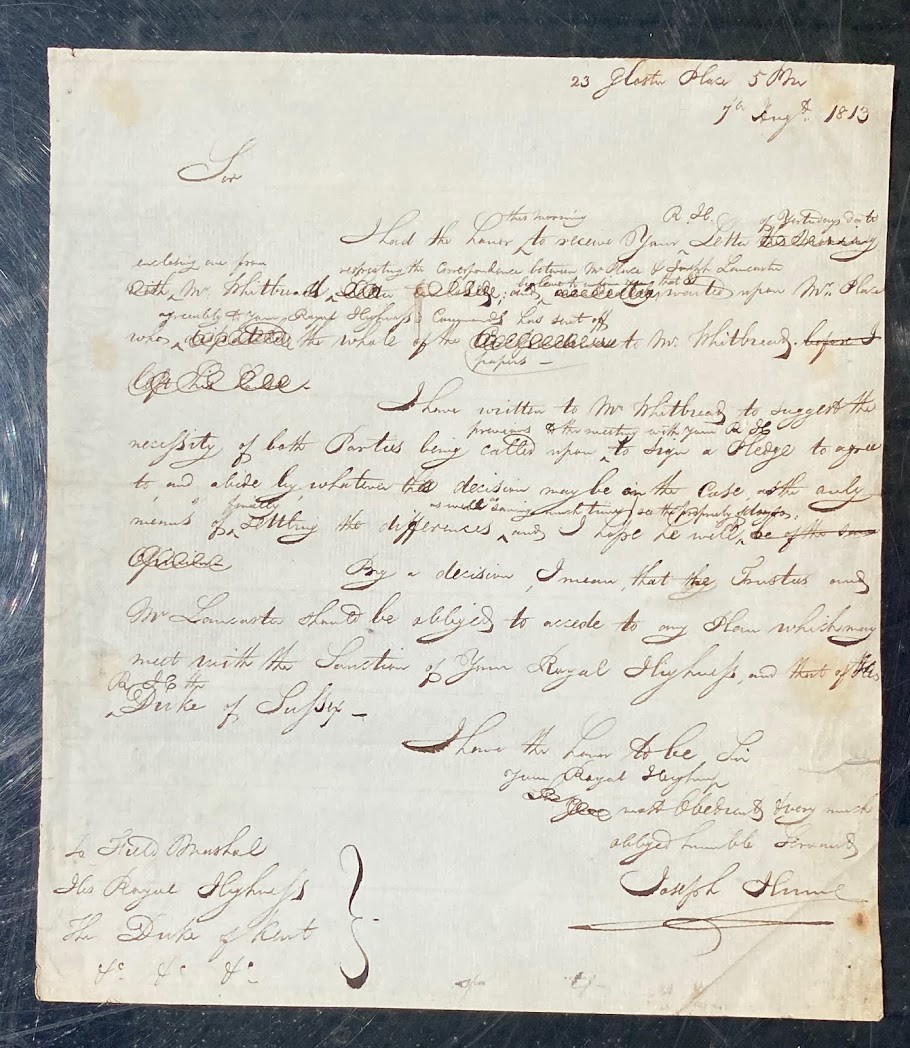
Adraft autograph letter signed from Hume to H.R.H. the Duke of Kent, 7thAugust 1813, 4to (9 x 7 ¾ inches), 1 page, with many corrections deletions andadditions, being a reply to the Duke’s letter of the day before, in which theDuke enclosed a letter ‘from Mr. [Samuel] Whitbread respecting theCorrespondence between Mr. [Francis] Place & Joseph Lancaster; and begleave to inform you that I waited upon Mr. Place who agreeably to Your RoyalHighness’s Commands has sent off the whole of the papers – to Mr. Whitbread. /I have written to Mr. Whitbread to suggest the necessity of both Parties beingcalled upon previous to the meeting with Your R H to sign a pledge to agree to and aoffere bywhatever the decision maybe on the case, and the only means of finally settlingthe differences as well as saving much time and I hope he will see thepropriety of doing [?]this. / By a decision. I mean that the Trustees and Mr.Lancaster should be obliged to accede to my Plan which may meet with theSanction of Your Royal Highness, and that of His R H the Duke of Sussex.”,precis to verso. Condition: oldfolds, one repaired tear.
A(possibly unpublished) letter which is important from a number of differentangles: letters of substance from Joseph Hume are quite rare; Joseph Lancasterand his (self-induced) difficulties; the high level of support he received;Joseph Hume’s first meeting with Francis Place; the high esteem in which Humewas held; the involvement of the Duke’s of Kent and Sussex in some quiteradical ideas/movements.
Joseph Hume first met Francis Place “when they wereintroduced by Joseph Fox on 30 July 1813 … [This] first meeting was with Placeresulted from a concern each of them had for the educational system devised byJoseph Lancaster. The scheme … called for the creation of schools wherechildren would teach other children … Ideally each Lancastrian school wouldcontain one thousand children taught in teams of ten by a hundred slightlyadvanced children [or monitors].
Lancaster’s plan had the virtue of promising inexpensiveeducation … Hume thought Lancaster’s system might lead to a truly national planof education and he became an active supporter in 1811.
At the time Hume was not aware of the difficultiesLancaster had faced during the first decade of the nineteenth century. Lack offunds proved the most serious problem. … In order to preserve the educationalexperiment, Lancaster’s supporters formed the Royal Lancastrian Association in1810 to help him manage his affairs. The governing committee of the associationincluded Place and [Lord] Brougham. For a year of so the … Associationflourished, and Lancaster opened many schools throughout the country. The progresswas short-lived. Inevitably, Lancaster’s independent personality and personalextravagance … led him into conflict with his creditors and members of thegoverning committee.
These were the problems that bought Hume and Placetogether… Their meeting was not accidental. It was arranged by the Duke ofKent, who asked Joseph Fox to see that Hume had every opportunity to discussLancaster’s difficulties with Place. The Duke was a patron and friend toLancaster, and he wanted to put an end to the continuing financial uncertainty.He had known Hume since 1812, and he had high respect for the Scotsman’business talent.
On 31 July, Hume had a rather lengthy discussion withPlace about Lancaster’s future. This time Hume bought word that the Duke ofKent had decided to bring Lancaster, his creditors, and the governing committeeof the … Association together to consider the prospects for getting out of thefinancial morass. The duke requested that Hume and Samuel Whitbread, aprominent radical politician, act as moderators… They were also to file areport on what they thought should be done in the future.
Lancaster did not appreciate the ‘interference’ of Humeand Whitbread … [and wrote] to Kensington Palace protesting that Hume andWhitbread were intolerable as moderators and ought to be removed. He wasparticularly critical of Hume. This brought a swift response from the Duke …[the moderators were both approved of, and that ]… the Duke had no intention ofretracting his choice, and the review of Lancaster’s operations proceeded” (R.K. Huch & P. R.Ziegler. ‘Joseph Hume: The People’s M.P” pp.8-10)