 On eBay Now...
1892 Vermont Academy Bill Saxtons River School Document Education Accountancy For Sale
When you click on links to various merchants on this site and make a purchase, this can result in this site earning a commission. Affiliate programs and affiliations include, but are not limited to, the eBay Partner Network.

1892 Vermont Academy Bill Saxtons River School Document Education Accountancy:
$10.00
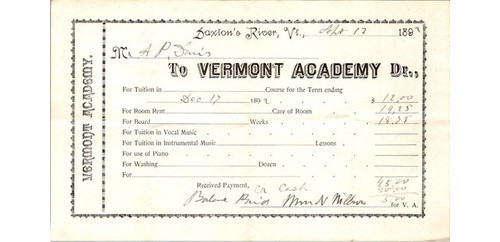
This 1892 Vermont Academy bill of receipt documents the educational expenses incurred by Mr. A.P. Davis at the Saxtons River, Vermont, institution. Dated September 17, the pre-printed form with manuscript accounting entries details charges for a term ending December 17, creating a complete financial record spanning the academic quarter. The itemization reveals a comprehensive boarding school fee structure, including $12.00 for tuition, $14.25 for room rent with an additional charge for room care, and $18.25 for board calculated by the week. Supplementary educational offerings are enumerated with blank fields for vocal music instruction, instrumental music lessons priced per session, and a separate fee for piano usage, reflecting the academy's commitment to a well-rounded curriculum. The document concludes with a payment record indicating a $45.00 credit applied against the total, leaving a $5.00 balance that was subsequently settled, as certified by the receiving signature of Wm N. Millns acting on behalf of the academy. The billhead serves as a significant artifact of late 19th-century educational finance and administrative ephemera, capturing the economic realities of private secondary education during the Gilded Age. Its combination of printed structure and handwritten particularization exemplifies standard accounting practices of the period, where customized financial instruments were created through the interpolation of individual student data into institutional templates. The document's provenance connects directly to Windham County's educational history, offering tangible evidence of Vermont Academy's operational procedures a decade after its founding. This piece of scholastic paperwork provides valuable insight into the commodification of education, from basic tuition to ancillary services like laundry, demonstrating how New England preparatory schools functioned as self-contained economic ecosystems while documenting the material culture of academic administration through its specific financial instrumentation.